
Saturday, October 8, 2016
Nine Princes in Amber, Chapter 2
Chapter 2: Corey makes his way to New York City and readies himself for his meeting with Evelyn. He hopes that she will jog his memories. However, when we meets his sister, Corey hides his amnesia behind bluff and non-committal statements. He manages to alleviate Evelyn's suspicions while navigating through a mire of family intrigue without knowing the lay of the land or the players involved.
Carl Corey is actually Corwin, a major piece in the chess game played by his family. One one side of the board is Eric, who is gathering support among the family, including Evelyn's. Corwin weaves his way through her conversational raps, suggesting that he might first support and then challenge Eric. Evelyn shifts her support to Corwin, revealing her name to be Florimel.
Woven throughout the conversation is talk of Amber, a land whose mention has an electric effect on Corwin.
***
I find it interesting that Florimel and Corwin are so trusting even as they verbally bluff and riposte. Corwin has little choice, as his memories are gone, but he gives Flora a measure of unearned trust. After all, she is the sister that kept him in Greenwood to be sedated. Additionally, Corwin is not liked by much of his family, which pleases him even in his amnesiatic state. Flora, however, is opportunistic, willing to toss aside her support to Eric if a better option presents itself. Given the intrigues of the children of Amber, she must suspect a trap.
Also odd is that Corwin shrugs off the simple fact that the car accident that sent him to Greenwood occurred only 15 or so days before. Broken legs can take six weeks to months to heal. His swift recovery is unremarkable to him, even without his memories.
***
Like many works prior to the fantasy explosion of 1977, the Chronicles of Amber does not sit easily in any one genre. Fortunately, in The Hand of Oberon, a self-inserted Roger Zelazney states that he is "...writing a philosophical romance shot through with elements of horror and morbidity."
Odd that for the naked intent of the author, philosophical examinations of the Chronicles of Amber are rare. I was only able to find one article seriously addressing philosophy, in the New York Review of Science Fiction. Perhaps John C. Wright, Michael Flynn, or one of their more philosophical fans might remedy this lack.
***
After many months of delay, the fourth book in the Chronicles of Amber, The Hand of Oberon, has finally been released on ebook. Hopefully it will not take as long for The Courts of Chaos to be released, followed by the five book Merlin cycle.

Thursday, October 6, 2016
All roads lead to Amber.
Some books are timeless, others, however, constantly remind you that they were written in a certain era. That is not necessarily wrong, though, and I think that Chronicles of Amber by Roger Zelazny are of that kind. In the first book of the series, Nine Princes in Amber, there are certain things like the style and language of the narrator, its philosophical and psychedelic themes, and the specific references to our world that seem to scream "This was written in the 70s!"
Nonetheless, the book(s) have outlived their time, and they are still a classic of fantasy, and through their (sometimes quite indirect) influence, they have helped shape a lot of contemporary fiction, and not only novels but also games, from D&D to Games of Thrones.
Now, for those who have not read the book, the basic plot of the book is about Corwin, the amnesiac member of a dysfunctional family of nine chainsmoking god-like brothers (there are also fours sisters who don't seem to matter that much) who fight over the crown of Amber, the real City of the real Earth. Apparently, almost as if it were the center of creation, Amber is the original archetype of a City, and all the other worlds, cities and civilizations (including our own planet) are a "shadow" of Amber, who is said to cast its shadow everywhere. The princes of Amber (the former king, Oberon, is currently AWOL) have some pressing sibling issues, but they are also stronger, smarter, and more powerful than any other human -real or from the shadow worlds- and in these worlds they are usually mistaken for gods, a belief the princes do not try to deny. Beyond all that backstabbing, there are also hints of something bigger going, like references to odd shadow beings, and something about "Chaos," but that's for the next books in the series.
About the book itself, I think that The Nine Princess of Amber (the first of the Amber series,) like other Zelazny's books, goes from impressive to clearly not so good in an instant, and the changes back again. It has parts clearly written by someone with a great knowledge of the craft, and then others that seem like someone is translating the instructions for a Chinese dishwasher. Although I'm sure other people may disagree, I think the quality of the book follows a V-shaped form. It starts great, with all that hardboiled gumshoe action, and it still great even when it suddenly gets so weird that even Philip K. Dick would shake his head in despair, but then (just when the action and the epic battles start,) the quality goes down. Perhaps it was just me, but there was a moment I got the impression I was reading the description of a spreadsheet of distances, time, weather, and casualties tabulations, not a real war to conquer the most important city in the multiverse.
Still, the failed invasion that Bleys and Corwin attempted fails quickly, and we find our beaten and blinded protagonist in a dungeon. I've read some people criticizing that part, usually because they believe it's boring ("where's the action!") but I think it's not only interesting but also necessary. Corwin's suffering humanizes him and gives him a certain personality and motivation he had lacked before. Sure, we know that his brothers had been fighting over some crown or somesuch for centuries, but we have no reason to care about that struggle. In fact, the whole thing is a bit solipsistic because it's almost as if there were only nine people alive in the whole Universe and the whole point of existence was just that crown and the brothers hating each other until the end of time.
"Thus did I bear Sir Lancelot du Lac to the Keep of Ganelon, whom I trusted like a brother. That is to say, not at all."
(that quote is not from the first book but the second one, but it would be a crime not to use it.)
Making him fail, and hard, is a perfect way to humanize him, to make him weaker and, yes, "normal," to give him a distinct character compared to that of his other brothers. That is why in the previous post I commented that you should read the first two books as one since the first one clearly looks like an introduction.
All doors lead to Sigil.
Roger Zelazny appeared in the fabled Appendix N but -unlike a more definite influence of Jack of Shadows on the thief class- trying to find how the Amber Chronicles shaped the original Dungeons & Dragons is a bit more difficult (to me, anyway.) But it did end up influencing D&D a lot, even if years later. A kind of time-warping retroactive influence that I'm sure Zelazny would have enjoyed.
In 1994 the Planescape Campaign setting was published, and with it the city of Sigil, The City of Doors:
"Sigil: the City of Doors. This town's the gateway to everything and everywhere that matters. Step through one door and enter the halls of Ysgard, or turn down a particular alley and discover the Abyss."
From the Player Guide to the Planes
And then there's this:
"The multiverse is a big place, and logically it has to be because hypothetically it encompasses every AD&D campaign world ever created, whether these are made by TSR or by any of the thousands of DMs who play AD&D games. This is all theoretical, of course, since no one has recorded all the campaigns created for the AD&D game, yet theoretically, they're all out there somewhere."
From the "A DM Guide to the Planes."
Although I haven't found any prove that David "Zeb" Cook was influenced by Zelazny's work when he designed the Planescape setting, it's hard not to think of Amber when reading about Sigil. The second quoted part also reminds me of those debates concerning the nature of the shadow worlds. Are they real, or are they a creation of the Princes of Amber who by conceiving them create them? It does not matter, or so the argument goes, what matters is that theoretically every world/campaign ever imagined or to be imagined should be there, somewhere. And in the center of it all, Amber/Sigil.
Then, in 1999, what is sometimes considered one of the best computer role-playing games, was published. It was Planescape Torment, and this is what his main writer (Chris Avellone) said about his influences:
"Zelazny was probably the biggest influence, since he was pretty much the master of writing stories with amnesiac heroes coming into their own.”
 |
The Nameless One, Planescape Torment protagonist, is not only an amnesiac who has lived hundreds or thousands of lives on different worlds/planes, but he (like Corwin) also has an incredible regenerative power. Unlike Corwin, however, power (e.g. Amber's throne) isn't the goal he seeks but to understand who he is (unlike Corwin, he doesn't regain his memory in the introductory chapters.) Also, his regeneration also seems to have some limits because he looks live he routinely sleeps in a combine machine, probably the inevitable result of his body having being destroyed hundreds of times.
The main theme of the game, the question "What can change the nature of a man?", that repeats itself through all of Nameless One's amnesic reincarnations and hunts him everywhere he goes, is probably a direct reference to something written in the second book of the Amber series, The Guns of Avalon:
"Why had no one ever come up with a way to change the basic nature of man? Even the erasure of all my memories and a new life in a new world had resulted in the same old Corwin. If I were not happy with what I was it could be a proposition worthy of despair."
Changing or not the nature of man, I'm glad that a book that was written almost fifty years ago and in a very specific style and era, still casts its shadow after all that time.
Wednesday, October 5, 2016
Hardboiled Fantasy
Now this is how a game of thrones should be played, by vicious backstabbing political princes with ever-shifting alliances and a whole lot less rape.
 |
| Source: Ayej (DeviantArt Page) |

Amusingly, looking at a bibliography just now to confirm how little of his work I have read, two names jumped out at me. One book is set in Saberhagen's 'Berzerker' universe and the second, of all things, is 'Damnation Alley'. That was a blast from decades past. I recall enjoying the movie as a young child, and reading the book years later only to be surprised at how much more sense everything made in the book. I was young.
For me, Nine Princes in Amber got off to a bit of a rocky start. The gimmick of an amnesiac protagonist, Corwin, learning of his past the same way the reader does - through slow and subtle discovery - may have been relatively new at the time the book was written, but it's been done so often now that I wondered what Nathan had signed us up for. That lasted until the amnesiac pulled a neat trick and effected an escape as clever as it is sudden and brutal.
The book's tone pulls a neat trick of its own, speaking with a very Dashielle Hammet style in the modern setting, and slowly fading into a more mythic and fairy-tale-ish tone the closer Corwin gets to Amber. Corwin seems to share the attitude of 'regretful willingness to do violence to get what he needs' of most hardboiled detectives, too. The frequent questioning of himself and concern for others that he counts a weakness adds to that feeling.
Another feeling that the book evoked in this reader is the feeling of datedness. Whenever else one considers Amber to exist, there's no doubt that Corwin is a product of the 1970s. He and his siblings drink and smoke constantly, even in a dank prison, and he commonly uses the verb 'to dig' as a synonym for 'to understand'. Use of the 1970s slang jangled against the gentle dreaminess of most conversation set in Amber, and pulled this reader out of the story. A minor quibble, but given how well the book is written, and how well it stands the test of time otherwise, that particular slang term stands out as a uniquely proud nail.
I'm not too thrilled that the book ends on such an obvious cliffhanger, even as I understood going in that it was the first of a series. Corwin is an agreeable protagonist, and the conflict had been nicely setup to the point that the remaining books in the series are now on my 'must read' list. Somewhere. I may have to select 'The Guns of Avalon' as my next Puppy of the Month, just to squeeze it in.
If September's posts are anything to go by, Frisky and Nate will open our eyes to all of the subtle references in the book, and its sequel move from 'must read' to 'must read now'.
Tuesday, October 4, 2016
Nine Princes in Amber, Chapter 1
Chapter 1: A hospital patient slowly comes to in a private room. Recognizing the symptoms of a long sedation, he immediately grows suspicious. Playing possum as a nurse checks in on him, he tries to recall what happened to him. But when it is time for his next dose of sedative, he sits up and refuses treatment. An orderly tries to force him to take the injection, but a low blow and an improvised blackjack lay out the staffer. Dressed in the orderly's scrubs,, the patient roams the hospital until he finds the records room. Threatening a lawsuit, he extorts his name, Carl Corey, his sister's name, Evelyn Flaumel, and her address from the clerk - as well as $500 in spending money. Corey then leaves the hospital in search of a cab.
Corey is in the Greenwood Private Hospital for a legitimate injury, as the only memories he can recall are about a car falling off a cliff into a lake. However, he is suspicious that someone is trying to keep him there as he recognizes the symptoms of narcotic overuse. He certainly exhibits those symptoms - memory loss, paranoia, and irritability - but nothing in the narration suggests that Corey's paranoia and irritability is unwarranted.
Rather, Corey's voice suggests the hardboiled detectives of film noir and the detective pulps. This impression is further strengthened by Corey's familiarity with violence and his hard-nosed negoitiating style. The genre conventions of the pulp detective add to the fantastic by grounding the first chapter in a foundation of reality. From the reader's perspective, Corey will journey from present day (at the time of Amber's writing) reality into a realm of pure fantasy. However, from the city of Amber's perspective, he will move from fantasy to reality, as Amber is the sun-source of reality that all other realms are dim reflections of. It is an excellent thematic touch, serving as an example of how drawing on other genres besides fantasy can strengthen a story.
At the same time, the grounding in reality is also a trope of the Lost World genre. In these stories, a person from the current day discovers a new world separated in time and/or space from the current world. Examples include children's tales such as Alice's Adventures in Wonderland and The Lion, the Witch, and the Wardrobe, epic fantasies including the Thomas Covenant series, and the Song of Albion, and alternate histories like the Crosstime Engineer and the 163X series. However the heyday of the genre was in the pulps, where Edgar Rice Burroughs' John Carter, Tarzan, and David Innes adventured through their own lost worlds - and sometimes each other's. Amber takes inspiration from the pulp versions by making Corey a competent man of action able to face the challenges of his strange new world by strength and cunning. Even from the reversed perspective to the reader of Amber, Corey's tale is the homecoming of an adventurer thought lost in a Lost World. Unfortunately for Corey, it will be the homecoming of Odysseus.
***
I have previously mentioned that Nine Princes in Amber was chosen because it was the leading suggestion by Puppies when asked for reading recommendations during the time of the Hugos and the Dragon Awards. I also had two other reasons for picking it. First, I noticed that on a couple of blogs that the editor of Nethereal, L. Jagi Lamplighter, has compared Brian Niemeier's work to that of Zelazny's. The latent literary critic within wants to see how and why that might be true. Second, I consider it a refutation of the common fandom assumption that readers only enjoy current works and that the past masters are impenetrable. I found that first chapter of Nine Princes in Amber to be more real/true/identifiable than the works of Sanderson, Rothfuss, and Lynch, all writers I enjoy and have a certain amount of respect for. Rather than just rant on the marketing inflicted myopia of the industry, I would also like to raise awareness of some of the classics so that new readers can find them. Fortunately, the ebook revolution is bringing the backlists of the past back to the marketplace, making the classics more accessible than they have been in years. For those of you reading along with us at the Puppy of the Month Club, you're in for a treat.
Friday, September 30, 2016
Nethereal Close-Out

In the meantime, if you enjoyed Nethereal and want to see more work like it out of Brian in the future, make sure you pick up a copy of the sequel, Soul Dancer. Who knows, it might just be a future Puppy of the Month itself!
A little easier and a lot cheaper thing you can do to support Puppy-related literature is to go leave a review over at Amazon.com (by clicking on this link). The inner workings of Amazon's algorithms are a mystery, but every review adds weight to a book's profile. So the more reviews a book has, the higher its visibility on Amazon. Word on the street is that 50 reviews is when Amazon really starts paying attention. As of this writing, Nethereal has 38. If you add one more note - even a quick two or three sentences - that will help get the book in front of more casual fans of sf/f. And that will help you get more Niemeierian works on the market.
Thursday, September 29, 2016
Nethereal, Chapters 61-66 and Epilogue
Chapter 61: Jaren shoots Zebel, who drops his father’s
soul stone. Mephistophilis splits bodily
from Teg and offers pardon. Vaun reveals
that the baal wants to subvert the Last Working to his own ends. Mephistophilis attacks the crew of the Exodus, defeating each in turn until Vaun’s void
drains the life from the demon. The baal
reappears in Teg’s body and feeds the last soul stone to the oracle. A god breaks free from the altar in a flurry
of geometric shapes.
Narr reveals himself
as the secret head of the Steerman’s Guild to Malachi in attempt to talk the
Guild master out of his revenge. When
that fails, he blesses Malachi’s wish to slit Jaren’s throat.
The sacrifice of high prana Gen souls is designed to replace
Thera with one-eyed Elathan as the god around which the Last Working is cast. Mephistophilis
intends to follow Elathan out of the universe as he is tired of living in a
universe that winding down like an old clockwork watch.
***
Chapter 62: Mephistophilis is still alive, having decoyed
Jaren and Vaun into killing Teg so that he could complete the sacrifice. He flees towards Timtzum, where Zadok created
the universe and where the Words of Creation are kept. Elena appears, warns everyone what could
happen if Mephistophilis reaches the Words of Creation, and resurrects Teg. The crew chases after the demon lord, pursued
by monsters.
To open the gate to
the Ninth Circle, Navkin warps the city of the Eighth Circle into concentric
rings. By spinning them in all
directions like a gyroscope, the gate opens to a land of ice, sleet, and hail.
Vaun states that Thera is of the Void and Zadok of the Well,
which aligns with traditional descriptions of yin and yang. However, the mythology of Nethereal states
that Zadok and Thera are ever fated to kill and transform into each other,
which might explain why Thera, in the form of Elena, has been connected to the
light of the Well throughout the adventure.
The icy description of the Ninth Circle is similar to the
frozen lake at the center of Dante’s Inferno.
***
Chapter 63: One last gate remains in the Ninth Circle,
which takes the Exodus to
Mithgar. They emerge in the midst of a
battle the Navy’s rebels are losing to the Guild fleet. Jaren moves to support the rebel fleet,
shattering the Guild formations. The Serapis and her supporting vessels emerge from
hiding and ravage the Exodus,
taunting Jaren on the comms. Jaren abandons ship in the Shibboleth alongside a shuttle presumed to be Elena’s. Meanwhile, the Exodus’s armor bulges and buckles under the Guild
fire, breaking open to reveal the pale form of Elathan.
In hindsight, it does not surprise me that there was another
gate in the Ninth Circle, or that it led to Mithgar. Dante left the frozen lake of his Inferno by
climbing down Satan’s legs before climbing through a cavern to the Earth’s
surface.
The armored angel/god once in the technological service to
humanity but now berserk is similar to the secrets of Evangelion’s mecha.
***
Chapter 64: Given the choice between chasing the
Shibboleth and destroying the Exodus, Malachi chooses the latter. Thus he has a front-row seat to a cosmic
horror finslapping his supports into dust.
Meanwhile, Jaren positions the Shibboleth behind the Serapis and fires on Elathan. The god of shipwreck charges the Serapis, worrying the ship like a rat before
flinging it down to Mithgar’s surface.
Elathan flies towards another gate in the stars, joined by Elena’s
shuttle and remnants of the two battle fleets.
Jaren orders the Shibboleth to
pass through the gate. On the other
side, they find the Mobius strip from Deim’s dream, complete with foreign words
on its surface. Golden beams lance out,
destroying many ship. The Shibboleth
attempts to land, but is shot down.
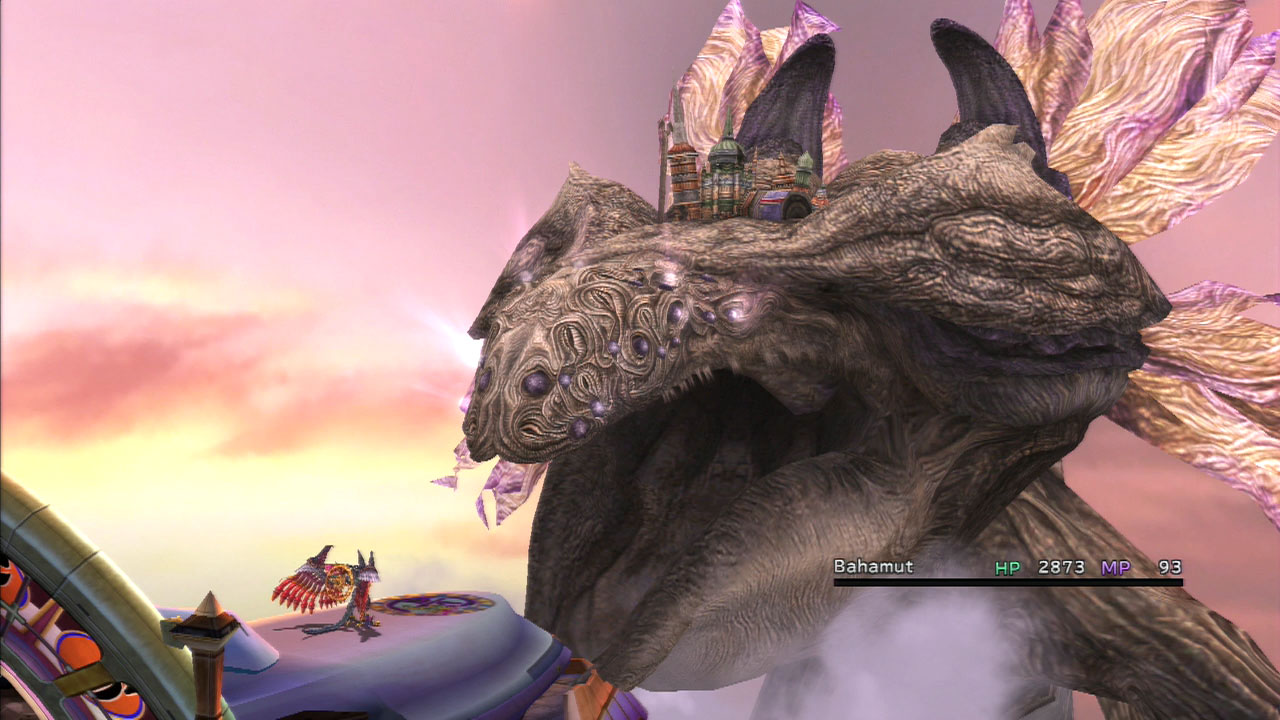
The description of a baleen monster that is part whale and
part ray recalls Sin from Final Fantasy X,
although, as a 3-D Final Fantasy game, the resemblance is likely accidental. It’s been a while since I’ve played FF VI, which does have direct influence
on the creation of Nethereal, so I don’t
remember if there is a beast similar to it in that game.
Malachi stares into the eye of Elathan before the attack. It is uncertain if he passed his SAN check…
The Shibboleth flies through one last gate, somewhat similar
to the transition in the Divine Comedy
from the Purgatorio on Earth to the Paradiso of Heaven.
***
Chapter 65: Jaren and his crew leave behind the wreck of
the Shibboleth to pursue Mephistophilis through the golden streets of
Tzintsum. The Gen captain confronts the
baal, which devolves into a fight.
Mephistophilis trounces Jaren and Teg, saying that he would have given
them honors for their act of service. As
he prepares to leave the universe, Navkin sacrifices her hellhound to give time
for Teg to recover and rush the baal.
Jaren manages to shoot Mephistophilis with a rodcaster. Although Tzimtzum is awash in molten metal,
the baal is not dead. Jaren tells everyone
to run and front loads his rodcaster.
Both baal and Gen disappear inside a small sun.
Elena appears, saying
goodbye as she must leave with Elathan.
Otherwise, to contain Thera’s soul within herself, she must read the
Words of Creation and end the world. If
another person reads them, she might be able to stay. As the words can only be read by a
necromancer, Deim must beat Vaun to the Last Working.
Tzimtzum is the golden city that Jaren dreamed of.
Necromancer here means Teth user, which explains why Elena,
as Thera’s soul, can read the words.
There is a passing resemblance between Mephistophilis and Sulaiman, the blond priest of Midras. The baal’s statement, “Midras is gone”, is also of interest. I do not see the two characters as being the same, but sharing characteristics of the people that worshiped Midras. Another name to watch for in Souldancer, just to see if –and likely when- Midras takes on a more prominent role in the story.
Zebel’s siring of Navkin makes Elena a motherless daughter
of a fatherless mother. No male genetic
material made Navkin, while Elena was a combination of two male fathers’
genetic material born spliced in Navkin’s egg cell. This symmetry was probably necessary to
prepare the vessel body for Thera’s soul.
***
Chapter 66: Dei falls for Vaun’s decoys. Elena dispels them, while he runs towards the
temple at the center of Tzimtzum. On a
tower reminiscent of Babel, Vaun prepares to read the Working. Deim attempts to stop him, but Vaun casts him
down from the tower. The First Working
is read. Deim awakens and looses an echo
of the Working stored within the artifact on his belt at Elathan, killing the
god. Fire races along the cables
connecting Elena to Elathan, consuming them.
As the ruined streets
burn, Elena tells Navkin and Teg, the only survivors of the Exodus’s trip
through hell, to flee. As they reach
safety through a portals in an arch, the Void in the form of Vaun confronts her. Elena has Thera’s soul, while Vaun has her
power. The Goddess of the Well faces off
against the God of the Void. She manages
to open a gate to the Void and seals Vaun within, replenishing the Well with
prana in the process.
Fire consumes
Tzimtzum.
Finding references to two Biblical stories on the walls of Tzimtzum
is curious, as Brian Niemeier insists that the universe is not our own. The stories are the Fall of Man and Tower of Babel, both of
which end in a scattering of people from a homeland and curses laid upon a
people. It is also curious that the 66th
chapter of Nethereal ends the tale with the advent of a god and fire falling on
heaven and the earths of the Middle Stratum, as the 66th book of the
Protestant Bible is the Revelation of John the Apostle, but that might also be
coincidence.
***
Epilogue: After
the fires that consumed Mithgar subsided, a survivor pulls himself free from
his shelter and screams in rage.
If this were not the first book in the series, the sudden
ending of Nethereal would work
against the story by not providing a satisfactory ending. Traditional five
act structure gives time for reflection by the characters after the climax
(or resolution in the diagram), typically devoting the same about of time to
the ending as was given the introduction. However, Nethereal
uses the extended introduction typical of two-cour anime
and ends right after the confrontation between Elena and Vaun is finished. As a hook for Souldancer, though, this works.
Where many writers, such as John Ringo, tend to treat their last chapter
and epilogue as denouement, this felt more like a Marvel post-credits
scene.
***
Final Thoughts:
Once again, Nethereal is not a book that rewards close reading so much as demands it. As such, I must recommend the paperbound version over the ebook format, as the ebook tends to promote skimming. Even after the what was a reread for me, I still feel like I missed more than I managed to catch.
I am impressed at how little description is needed in Nethereal to create its haunting mood. Instead of detailing the setting and action with the clarity of a photograph, Niemeier paints with broad strokes, allowing each reader to fill in the gaps with their own mind. This makes the horrors of the Nine Circles more vivid as no written description or visual image can beat that created in the reader's mind. This approach is used to great effect by Hitchcock and other thriller directors in the days before directors could rely on special effects for scares, as the monster that cannot be seen is often scarier than the monster that is seen. Most anime influenced fiction swings instead towards more explicit description as they try to mimic the visual nature of anime.
Had I the time, I would have liked to delve in detail into such topics as story structure, anime influences, and how the dueling genre conventions of the Master Thief and the Pirate Captain shaped how the story of Nethereal was told. I did touch on some of these topics in the read through, but I either scratched the surface or could develop the ideas further. Nethereal is so content rich that there was always something new to follow in each chapter.
I would also like to investigate how Final Fantasy VI influenced Nethereal and Souldancer, but that will require a read of Souldancer as Nethereal only has resonances to the first half of the game's plot.
Next month's selection is Nine Princes in Amber, by Roger Zelazny.
In the Same Vein: Recommendations for Nethereal Fans
Making recommendations of works similar to Nethereal is a tall order, as Brian Niemeier has drawn from many influences to create what Jeffro Johnson has called “Anime-Fueled Fantasy/Sci-Fi/Horror Cosmological Action.” Not many works match that genre description, and fewer the mood of Nethereal. So, this month, my recommendations will focus on works that share aspects of Nethereal's milieu, from cosmological horror to grim space piracy. And, as anime has influence Brian Niemeier's writings, I have included two series as well, although the focus remains on the written word.
This list is not intended as definitive, and all plot descriptions are taken from the back covers.
Sequels:
This list is not intended as definitive, and all plot descriptions are taken from the back covers.
***
Sequels:
Souldancer, by
Brian Niemeier. (Preview.)
Twenty years after the old world ended in fire, Xander Sykes travels the deserts of a drastically changed Mithgar. His fascination with the world he never knew—along with his strange abilities—divides him from his clan. But otherworldly forces interrupt his exile. Pursued by enemies from above and beneath the world, Xander bands together with an ambassador from hell, his heavenly bodyguard, and a reformed guildsman seeking to right his order’s wrongs. The search for answers leads to a vast, decaying city haunted by a presence as tormented as it is deadly. Xander finds a survivor who may give purpose to his nameless longing—if he can help her escape the terror that stalks them both.
The sequel to Nethereal opens up the cosmology even further, developing aspects of the mythology only glimpsed at in the first book. It also shows how the universe is recovering from Elena's tampering with the White Well. Probably the only book out there like Nethereal, for obvious reasons.
***
Print Works:
Awake in the Night Land, by John C. Wright.
Awake in the Night Land, by John C. Wright.
Part novel, part anthology, the book consists of four related novellas, "Awake in the Night", "The Cry of the Night-Hound", "Silence of the Night", and "The Last of All Suns", which collectively tell the haunting tale of the Last Redoubt of Man and the end of the human race.
These four tales, set in the nightmarish world of William Hope Hodgson's The Night Land, captures the horror -and the hope- of the last remaining city of man as it stands besieged for millions of years by alien monstrosities.
-
Hyperspace
Demons, by Jonathan Moeller. In space, the demons can hear you scream.
Space travel has always come with risks. But hyperspace travel comes with one particularly frightening risk, namely, the non-corporeal dark energy-based macrobiotic entities that inhabit the void and are drawn to the presence of human minds. Once penetrated by a macrobe, the infected human mind rapidly devolves into raving insanity, which usually presents in a homicidal manner. Fortunately, hyperspace-capable ships are protected by a dark energy resonator that keeps the macrobes away and thereby permits safe interstellar travel.
But what happens when a ship’s resonator is sabotaged while it is traveling through hyperspace? And who would be so insane as to unleash a demonic infection of mutating madness on an entire ship’s crew?Space horror done right, both in theme and in storytelling.
-
Inferno, by Larry Niven and Jerry Pournelle. After being thrown out the window of his luxury apartment, science fiction writer Allen Carpentier wakes to find himself at the gates of hell. Feeling he's landed in a great opportunity for a book, he attempts to follow Dante's road map. Determined to meet Satan himself, Carpentier treks through the Nine Layers of Hell led by Benito Mussolini, and encounters countless mental and physical tortures. As he struggles to escape, he's taken through new, puzzling, and outlandish versions of sin--recast for the present day.The classic science fiction retelling of the Divine Comedy.
-
Lord of Light, by Roger Zelazny. Earth is long since dead. On a colony planet, a band of men has gained control of technology, made themselves immortal, and now rules their world as the gods of the Hindu pantheon. Only one dares oppose them: he who was once Siddhartha and is now Mahasamatman. Binder of Demons. Lord of Light.Like Nethereal, this one is hard to describe, but an excellent read. Had this been available in Kindle, it would have been the October Puppy of the Month.
***
Visual Works:
Harlock: Space Pirate. (Movie trailer and first ten minutes. )
Harlock: Space Pirate. (Movie trailer and first ten minutes. )
Many years into the future, battle has been raging across the galaxies as 500 billion humans, whose forebears were exiled from Earth, plan to return to what is still called home. Forced to flee a ravaged Earth, humans have now depleted the corners of the galaxy to which they fled. Earth has now become the most valued and precious resource of all, controlled by the corrupt Gaia Coalition which governs the human race across the different galaxies. Captain Harlock and his trusted crew are the only hope mankind has of discovering the secrets that the Gaia have kept hidden.
The lord of all space pirates flies the Jolly Roger in rebellion once more.
-
Neon
Genesis Evangelion. (Rebuild movie
trailers: 1.11, 2.22, & 3.33.) Tokyo-3 still stands after most of civilization was decimated in the Second Impact. Now the city endures the ceaseless onslaught of the deadly Angels, bizarre creatures bent on eradicating the human race. To combat this strange and ruthless enemy, the government agency NERV constructs a fleet of towering humanoid machines, the Evas, and Shinji Ikari is called into action, reluctantly taking his place at the controls of Eva Unit 01. Living a life of loneliness and questioning his existence, Shinji struggles to accept responsibility for mankind's battle for survival.Combining mecha, psychological horror, and the Japanese fascination with mythology, this landmark series spawned a media empire of TV series, movies, manga, games, and more. It is currently undergoing its own Galactica-like remake in a series of four Rebuild movies. The TV series, although considered a classic, is harder to find through legitimate means than the Rebuild movies as its American distributor has gone out of business. Probably the closest match to Nethereal of all the recommendations listed.
***
It is certain that I've left out some deserving recommendations, so feel free to add your suggestions in the comments below.
Subscribe to:
Posts (Atom)